

How To Install Cal License In Windows 2008 Server

Client Access Licenses and Management Licenses
If the workstations in your organization are networked, you likely depend on network server software to perform sure functions, such as file and print sharing. To access this server software legally, a Customer Access License (CAL) may exist required. A CAL is non a software production; rather, it is a license that gives a user the correct to admission the services of the server.
Likewise, if you manage the devices on your network past using management software such as Microsoft System Centre, a Management License (ML) may exist required for the device being managed.
Overview
Licensing software with CALs and MLs tin be complicated due to the technical nature of server products and networks. Microsoft offers a device-based CAL (Device CAL) or a user-based CAL (User CAL) for purchase. In addition, an External Connector (EC) license is offered for some products as an optional culling to address specific customer scenarios.
For managing devices, Microsoft offers Server MLs for managing server operating arrangement environments (OSEs). For managing not-server devices, Microsoft offers OSE Client MLs and User Client MLs.
This overview is for reference purposes but. Earlier purchasing, you should visit the "How to Buy" section for each production and consult your Microsoft representative or local reseller regarding your specific licensing needs.
User CALs
With the User CAL, yous buy a CAL for every user who accesses the server to apply services such as file storage or printing, regardless of the number of devices they use for that access. Purchasing a User CAL might make more sense if your company'south employees need to have roaming access to the corporate network by using multiple devices, or from unknown devices, or if y'all simply have more devices than users in your organisation.
Client Access License based on user
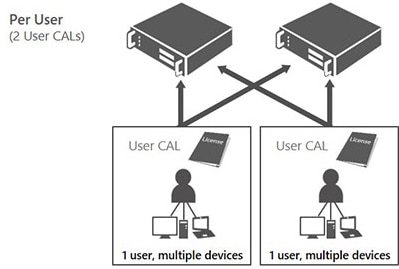
Client Access License based on user
Device CALs
With a Device CAL, you buy a CAL for every device that accesses your server, regardless of the number of users who use that device to access the server. Device CALs may make more economical and administrative sense if your company has workers who share devices, for case, on different work shifts.
Client Admission License based on device
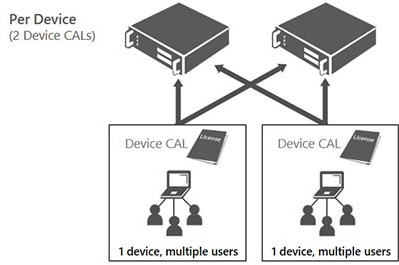
RW9TWE
External Connectors
If you want external users—such as concern partners, external contractors, or customers—to be able to access your network, you have two licensing options:
- Larn CALs for each of your external users.
- Acquire External Connector (EC) licenses for each server that volition be accessed by your external users.
External Connector licensing
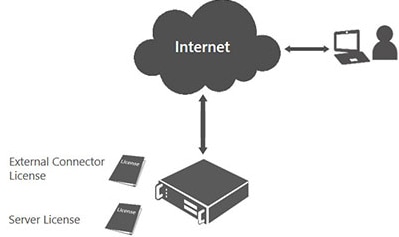
External Connector licensing
An external user is a person who does not have employee-level access to your company'due south network or the network of your affiliates, and is not someone to whom y'all provide hosted services. An EC license assigned to a server permits admission by any number of external users, as long every bit that access is for the benefit of the licensee and not the external user. Each physical server that external users access requires but ane EC license regardless of the number of software instances running. An "instance" is an installed copy of software.
The right to run instances of the server software is licensed separately; the EC, like the CAL, simply permits access. The decision on whether to acquire CALs or an EC for external users is primarily a fiscal ane.
Server Licensing not requiring CALs
Some server products are available to exist licensed on a "per core" or "per instance" basis.
Per Core licensing
Under the Per Core model, when the server software is running in the physical OSE, you must license all concrete cores on the server. To make up one's mind the number of core licenses y'all need, count the full number of concrete cores for each processor on the server, then multiply that number by the appropriate cadre factor. You do non demand to purchase additional CALs.
Software licensed by core
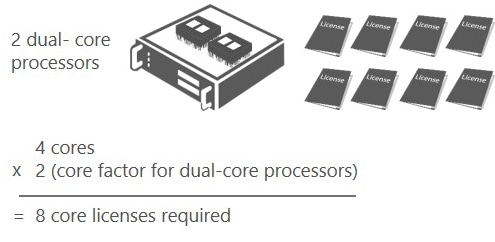
Software licensed by cadre
Specialty Server licensing
Specialty Servers are server-only licenses that by and large do not require CALs. Specialty Servers require a server license for each instance of the server software running on a server. You can run the case in a physical or virtual operating system environment. By exception, some products provide more specific use rights.
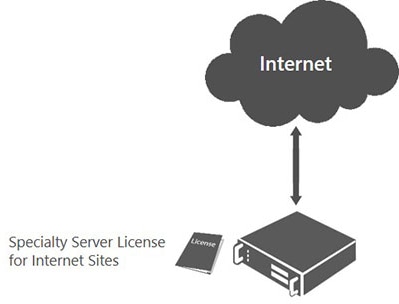
Specialty Server licensing
Examples of Specialty Server licensing include Windows Server Essentials and Forefront Identity Manager - Windows Alive Edition.
Direction Server licensing
Under the Management Servers licensing model, yous must larn and assign the required number of appropriate category (server and/or client) and blazon (OSE and/or User) of ML to the device on which OSEs are to be managed. Included with the ML are the rights to run the respective management server software, so y'all do not need to acquire separate licenses for the management server software.
Management of server OSEs requires Server MLs (only OSE type offered), while management of non-server OSEs require Client MLs (OSE/User types offered).
Software licensed past ML
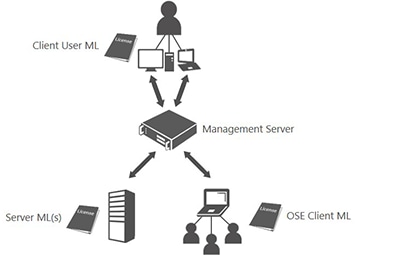
Software licensed by ML
For a list of Microsoft Server products and their applicable CALs or MLs, meet the Product CALs and MLs tab.
Related resources
Observe answers to the most common Microsoft production licensing inquiries from customers like y'all.
Locate employ rights, points by program, and special notes for individual products and supporting documents related to Volume Licensing.
Review this scenario-based guide to assistance you lot sympathise how Microsoft licensing models utilize to common IT solutions.
Get activation instructions including which products require a key.
Get help with thinking about User CALs vs. Device CALs in the context of factors such as compliance, overall cost, user profiles, and organizational growth.

Source: https://www.microsoft.com/en-us/licensing/product-licensing/client-access-license
Posted by: smithhationt.blogspot.com
0 Response to "How To Install Cal License In Windows 2008 Server"
Post a Comment