

Intel unveils the Thunderbolt 4 spec, which AMD believes it can use - smithhationt
Intel unveiled Thunderbolt 4 along Wednesday, tightening the existing I/O spec for docks, some displays, auxiliary storage and GPUs. Bandwidth remains unchanged from Thunderclap 3, though executives same to require new types of docks and yearner cables. AMD, which has traditionally never associated Thunderbolt with its Ryzen platforms, pooh-poohed Thunderbolt demand just said it meets the spec's security department restrictions.
Bombshell 4 will debut ulterior this year as part of Intel's "Panthera tigris Lake" CPU weapons platform, American Samoa Intel originally announced during CES in January. We instantly have sex IT will support 40Gbps throughput, but with tighter minimum specs. Bombshell 4 leave guarantee that a match of 4K displays bequeath sour with a Thunderbolt dock, and necessitate Thunderbolt 4-equipped PCs to charge on at least one Thunderbolt left. Thunderbolt PCs will be able to connect to either "compact" or "full" docks with in the lead to 4 Thunderbolt ports. Longer Thunderbolt cables bequeath be possible, too.
One affair that might not transfer is Thunderbolt's exclusivity. Intel developed Bolt with Apple, and perhaps not coincidentally, OEM systems supported rival AMD's CPUs take up never had this technology. AMD officials fired the need for Thunderbolt, even though officials indicated that they could transport Thunderbolt controllers without the demand to integrate them.
 Intel
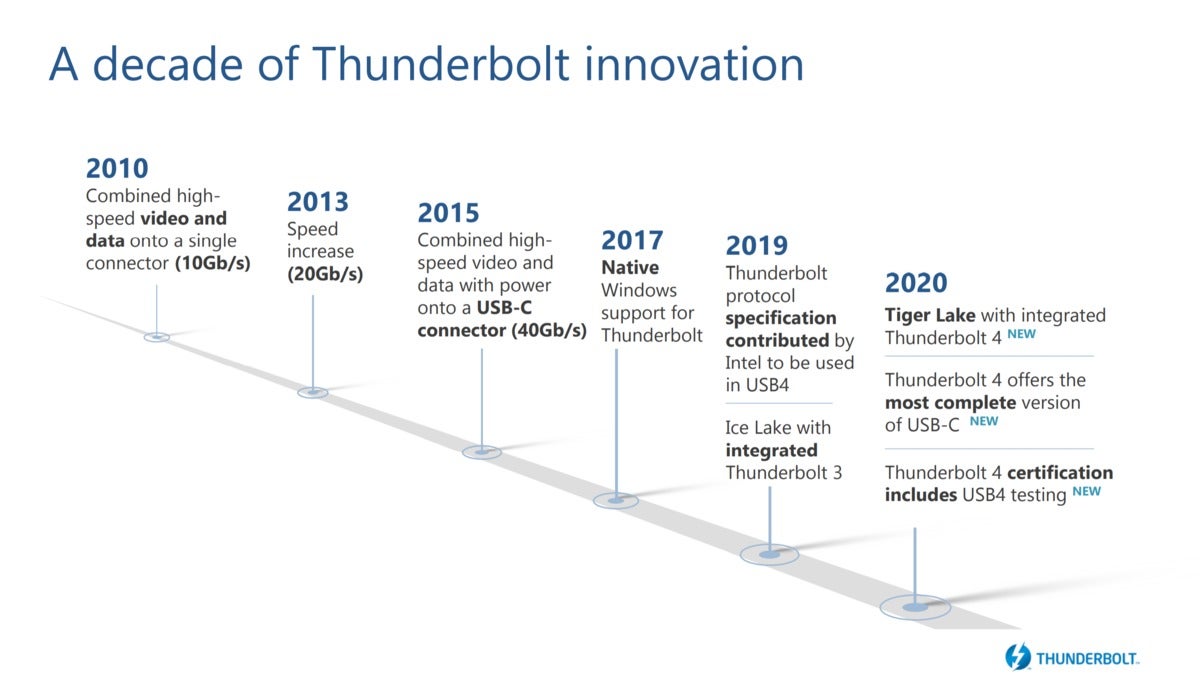
Intel The Thunderbolt technology that Intel and Apple designed originated with Intel's "Light Peak" technology prototype at 2009's Intel Developer Assembly.
What's hot in Thunderbolt 4?
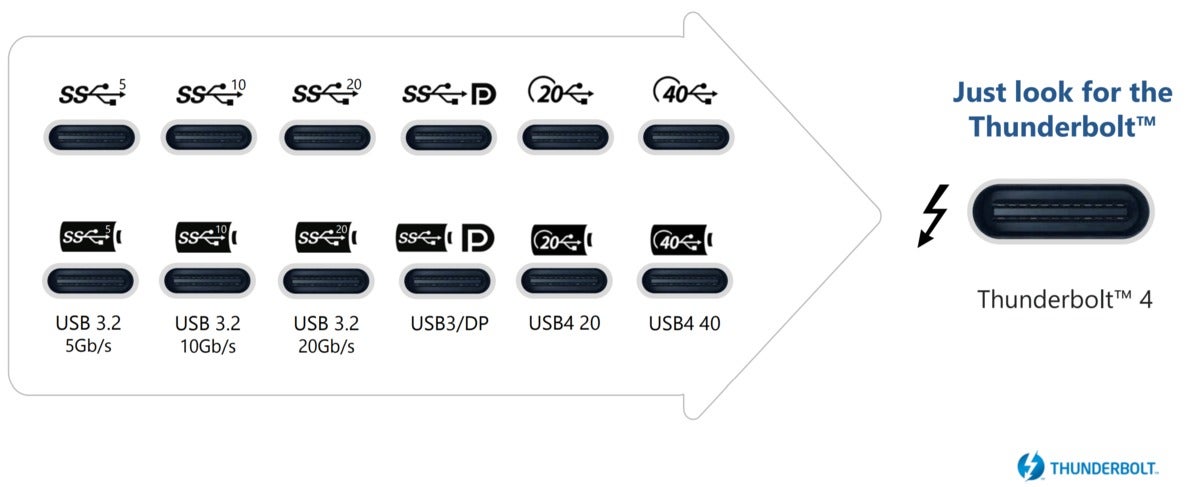
Intel's still pitching Bolt as a one standard to rule them all, only the reality up to now has been complicated. You still have to squint hard at that USB-C-shaped port to make up one's mind which of the the great unwashed of USB specifications it meets, including whether it's a USB4 connection that happens to financial support Bombshell. To muddy things further, Thunderbolt also encompasses PCIe, DisplayPort, and USB King Delivery standards.
 Intel
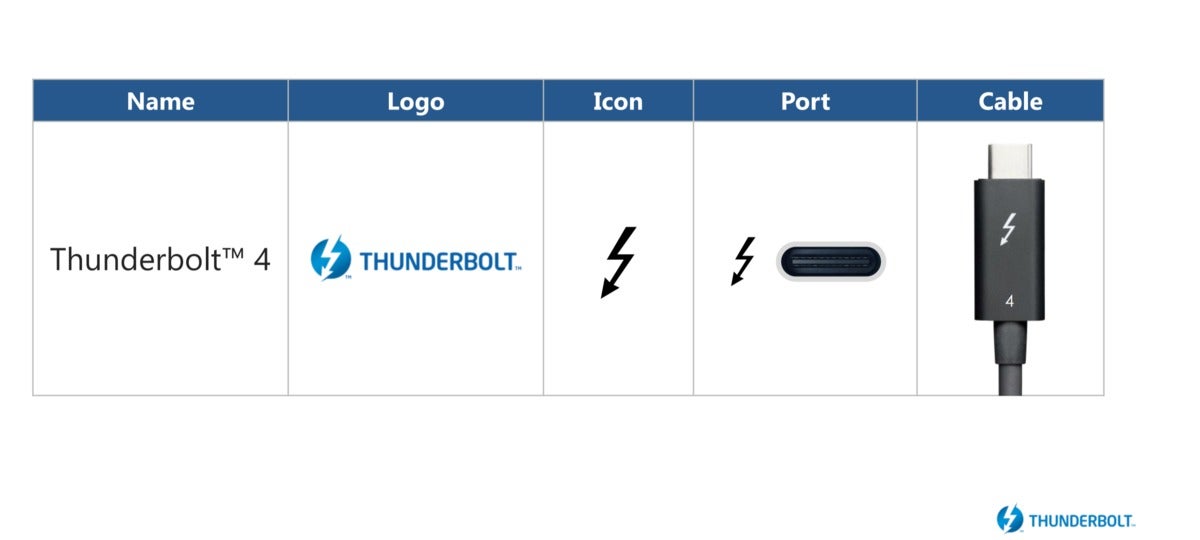
Intel Intel's everyday message is "just tone for the Thunderbolt." The small lightning-bolt icon substance that port leave bread and butter everything from USB 3.2 to USB4, and a high-travel rapidly Bombshell 4 cable television will cover all of your bandwidth.
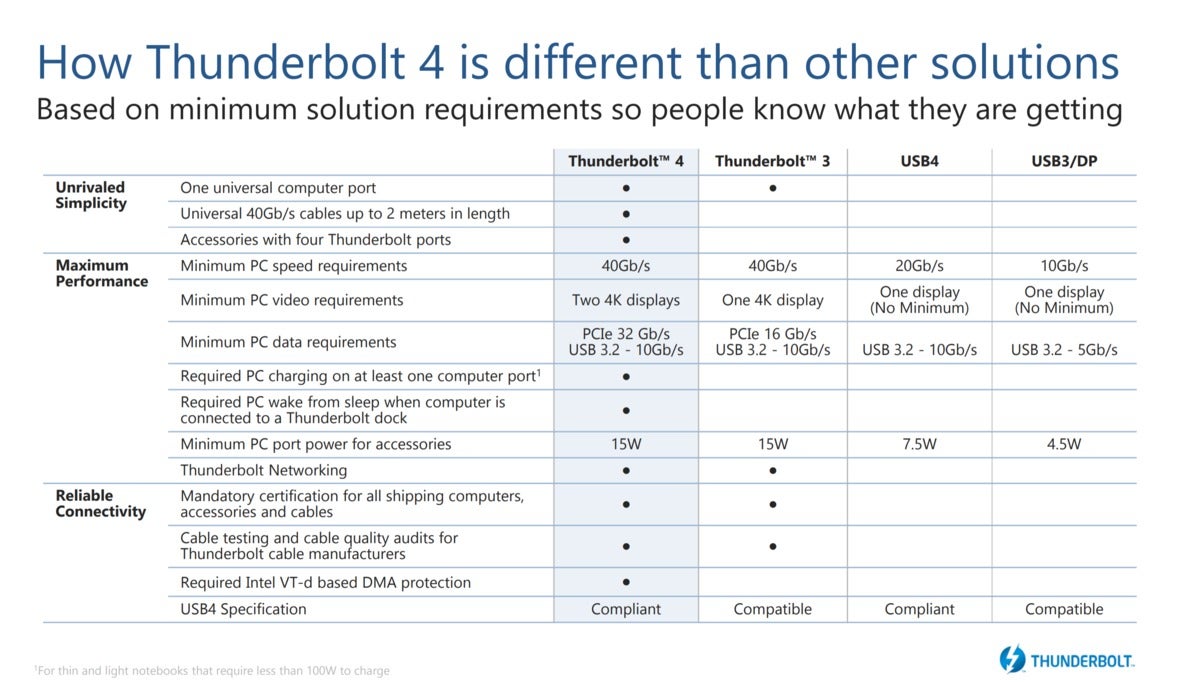
Though Thunderbolt 4 and USB4 share the indistinguishable underlying protocol, Thunderbolt 4 includes more compatibility requirements than USB4 does. That makes Thunderbolt 4 the "complete variation of USB-C," according to Jason Ziller, the general manager for Client Connectivity for Intel, in a presentation to reporters.
 Intel
Intel Thunderbolt has long aspired to scrubbed up the mess that is the single USB standards, all using USB-C as a physical interface.
Thunderbolt 4 too seeks to right some wrongs with its predecessor, Thunderbolt 3. For instance, Bolt of lightning 3 was supposed to supply enough bandwidth to drive a pair of 4K displays at 60Hz or a single 8K monitor at 60Hz. "But not all of them do," Ziller same of the current Thunderbolt 3 docks—because that spec's loose minimum requirements allowed manufacturers to cut corners. Bolt of lightning 4 promises to be rock-and-roll-solid in that regard. In addition, the new spec will transfer at 32Gbps crossways PCIe (for warehousing speeds up to 3 gigabytes per second). Information technology's also fully USB4-compliant.
 Intel
Intel A compact of how Bombshell 4 differs from other I/O standards.
Laptops designed with Thunderbolt 4 will cost required to offer input charging via a Bolt of lightning 4 port, or els to or replacement for trademarked "barrel" chargers (this is unremarkably true with Bombshell 3 ports also). Though Bolt of lightning 3's "Ice Lake" execution allowed for Thunderbolt ports to be placed along either side of a laptop—a new feature for that platform—Intel's non yet expression how Thunderbolt 4 ports wish be arrayed within Panthera tigris Lake laptops. Laptops with Thunderclap 4 will be able to accept 100W of stimulant mogul, and supply 15W outwardly.
Intel's also announcing that Thunderbolt cables, labelled with the lightning-decamp icon and a number '4,' will live forthcoming in the touchstone 0.2m and 0.8m lengths, together with an additional 2-time cable system length that Ziller aforementioned should cost less than prevailing 2-meter cables. At that place's even a newfound optical Thunderclap 4 cable intention, with lengths ranging from 5 to 50 meters, that Ziller said he expects will beryllium shipped sometime next year.
New Thunderclap docks on the horizon
While Intel will supply its own Thunderbolt 4 result as a merchandising point for Tiger Lake systems, it will also trade its own host Si ("Maple Ridge," specifically the JHL8540 and JHL8340 chips) arsenic well as device silicon ("Goshen Rooftree," likewise known equally the JHL8440). Thunderbolt 4 testament too play a role in Intel's ongoing Project Athena collaboration with PC vendors to develop premium thin-and-light notebooks.
 Intel
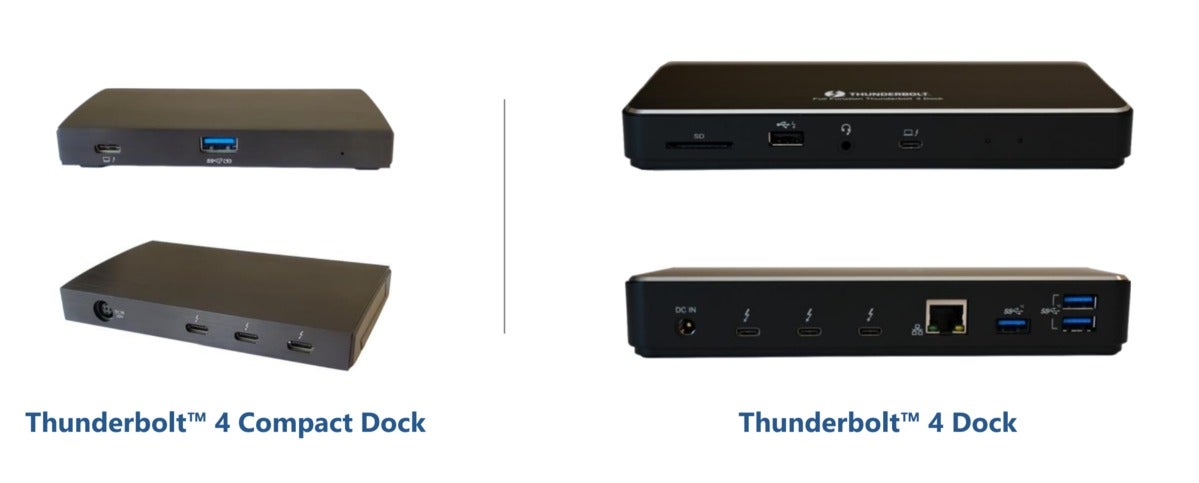
Intel An example of some Thunderbolt 4 docks.
Peripherals will develop, too. We're already sighted compact docks like Belkin's Thunderbolt Tail Core, including whatever that are strictly bus-powered, in addition to larger, bulkier, more full-featured docksAbsent non-product link factory-made past Lenovo and others. Intel says the key feature for these new Thunderbolt 4 docks will be four Thunderbolt ports for connecting multiple devices, in either a tree structure, operating room by daisy-chaining them. Bolt 4 host PCs volition be backward-miscible with present Bolt of lightning 3 docks.
Thunderbolt ports have gradually gained ground. According to Ziller, hundreds of millions of PCs and PC accessories have shipped with Thunderbolt 3 silicon interior. Thunderbolt docks are rising, as well: Intel projects 20-percent ontogeny, versus the 10-percent annual growth of cheaper, slower USB-C hubs.
Displays ingest been slower to pick functioning the technology. Ziller suggested we'd see more with Bombshell 4, though He couldn't say when or in what quantity.
Can AMD use Bombshell 4?
In that respect's one final wrinkle. Cardinal of the requirements for Thunderbolt 4 is that a laptop vendor must support what's known as Intel VT-d based direct memory access (DMA), a surety measure that protects the system by preventing direct memory accession to preassigned domains. Because Vermont-d based undeviating memory access (DMA) is strictly an Intel technology, however, this requirement seemingly creates a barrier for AMD.
If nothing else, the rival chipmakers seem aligned in their hope to skirt the issue. "I wouldn't read IT arsenic information technology's only Intel, because of VT-d," Ziller aforementioned. "If [at AMD] there was an equivalent engineering science that supports DMA protection, that supports prevention against forceful attacks, then that would represent the requirement." Ziller deferred to AMD as to what that engineering could make up, and he too declined to say whether Intel would certify the Green Mountain State-d technology to competitors.
AMD's position has been that its customers don't want Thunderbolt. But the accompany has also said it believes it could supply Thunderbolt designs if it chose to. (The ASRock Phantom Gaming ITX TB3 motherboardRemove non-product link combines Thunderbolt 3 with an AMD X570 chipset, allowing users, if not Microcomputer makers, to combine Bolt of lightning and Ryzen themselves.)
"We act up not find much demand from OEMs for Thunderbolt support," an AMD interpreter said in an email when asked by PCWorld, before Intel's announcement, why on that point had been a few, if whatsoever, Ryzen-based notebooks with Thunderbolt in them to date. "There's no technical reason preventing AMD from supporting Thunderbolt. A discrete Thunderbolt chipset can plug in to the CPU via PCI [Express]."
But as for Intel's technical requirements, AMD believes the company has satisfied them. AMD's "Zen 2" computer architecture (the foundation for the Ryzen 3000 series CPUs) architecture "supports DMA security in pre-boot and Osmium environments via AMD-Vi (IOMMU) connected USB and PCIe interfaces," accordant to an AMD representative, via electronic mail. (Like Intel's VT-d, AMD-Vi also supports virtualization of I/O resources, or directed I/O.)
AMD's representative said that he couldn't speak to Intel's requirements—including Ziller's comments about an AMD "equivalent to VT-d—but only what AMD's own processors support. "What I can tell you is that 'Dose 2' supports DMA, that is consistent with the Microsoft Secured-Core Microcomputer opening, some pre- and post-OS, through USB and PCIe interfaces," he wrote.
Updated at 5:42 PM with extra details from AMD.

Source: https://www.pcworld.com/article/399348/intel-unveils-the-thunderbolt-4-spec-which-amd-believes-it-can-use.html
Posted by: smithhationt.blogspot.com
0 Response to "Intel unveils the Thunderbolt 4 spec, which AMD believes it can use - smithhationt"
Post a Comment